
The Monkey Banquet of Lopburi
Feature — Unusual Festivals series. In Lopburi, Thailand, the Monkey Buffet Festival lays out a banquet of several tons of fruit for the town's macaques every last Sunday of November. Behind the country's most photographed party: a legend, a thank-you, and a very current debate.
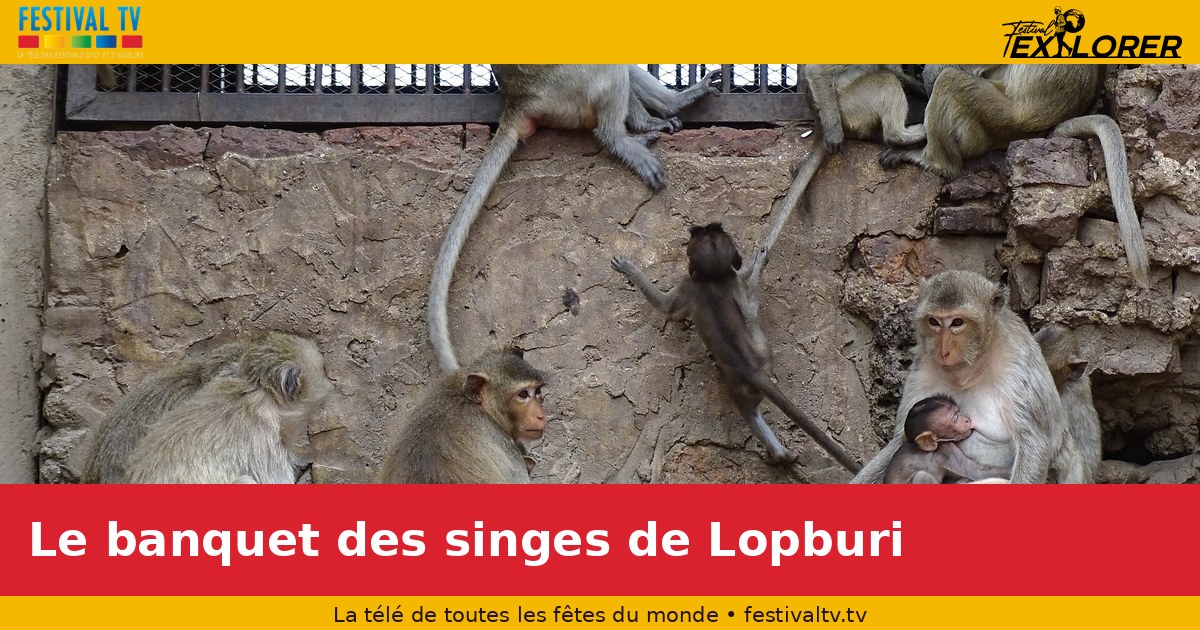
A banquet laid out for four-legged guests
On the last Sunday of November, in front of the Khmer towers of the Phra Prang Sam Yot temple in the heart of Lopburi, tables are set as if for a wedding: pyramids of watermelons, ice sculptures, mountains of fruit and Thai sweets. The guests of honour arrive across the rooftops and the power lines: they are the town's macaques, hundreds of diners hurling themselves at the feast. In 2026, the Monkey Buffet Festival takes place on Sunday, November 29.
The monkeys of Lopburi
Long-tailed macaques — also called crab-eating macaques — have lived in Lopburi forever, around the 13th-century temple and the neighbouring San Phra Kan shrine. They number in the thousands across the old town, on ledges, poles and rooftops. For residents, they are not strays: they are the historic hosts of the place — unruly, prone to stealing glasses and cans, but at home.
The legend of Hanuman
In the Ramayana, the great epic Thailand made its own as the Ramakien, the monkey god Hanuman helps Prince Rama rescue his wife Sita from the demon Ravana. Local legend says that Rama, in gratitude, gave Hanuman the city. Lopburi's macaques are therefore seen as his descendants: they bring luck and prosperity, and they are not driven away.
1989: the hotelier who said thank you
The festival was born in 1989, from an idea by Yongyuth Kitwatanusont, a local hotelier. His reasoning fits in one word: gratitude. The monkeys draw visitors from all over the world and keep Lopburi alive; he decided to thank them with a feast, backed by Thailand's tourism authority. During festival week, the monkeys are even handed 'invitations' topped with cashew nuts. The banquet has become one of Thailand's most photographed events, drawing around 10,000 visitors.
The values: gratitude and living together
The spectacle may raise a smile, but the gesture says something deep: a whole town acknowledges what it owes its animals and stages, one day a year, a reversal of roles — the humans serve, and the monkeys sit at the table. The festival opens with dances and monkey costumes, in joy: Lopburi celebrates its own story as much as its macaques.
The honest look: a coexistence under debate
Not everything is rosy in Lopburi. The macaque population grew, and so did conflicts with residents — raided shops, harassed passers-by — peaking in 2024. Authorities responded with sterilisation and relocation campaigns. Since the post-Covid restart, the main banquet is held mostly at the Monkey Sanctuary next to the temple: its large cages, housing hundreds of macaques, are criticised by animal-welfare campaigners, and smaller gatherings continue at the temple. Today's festival is no longer quite yesterday's, and Thailand debates it openly — that, too, is what a living festival is.
Practical information
Lopburi is about 150 km north of Bangkok, a two-hour train ride: an easy day trip. The festival is free to attend; a small fee applies to visit the temple ruins. The main feast happens late in the morning. On site, keep your distance, do not feed the monkeys outside the festival, and hold on tight to your bags, glasses and drinks: the guests have light fingers.
Monkey Buffet Festival — Phra Prang Sam Yot, Lopburi, Thailand. Last Sunday of November; in 2026, Sunday, November 29.
Tourism Authority of Thailand, Lopburi office: official Facebook page.
— Moïse 1er, the Festival Explorer